One light.
Every shadow.
One light, every shadow, no compromise.
From a hard shadow to a soft one without changing fixture, without changing position, and without touching the set.
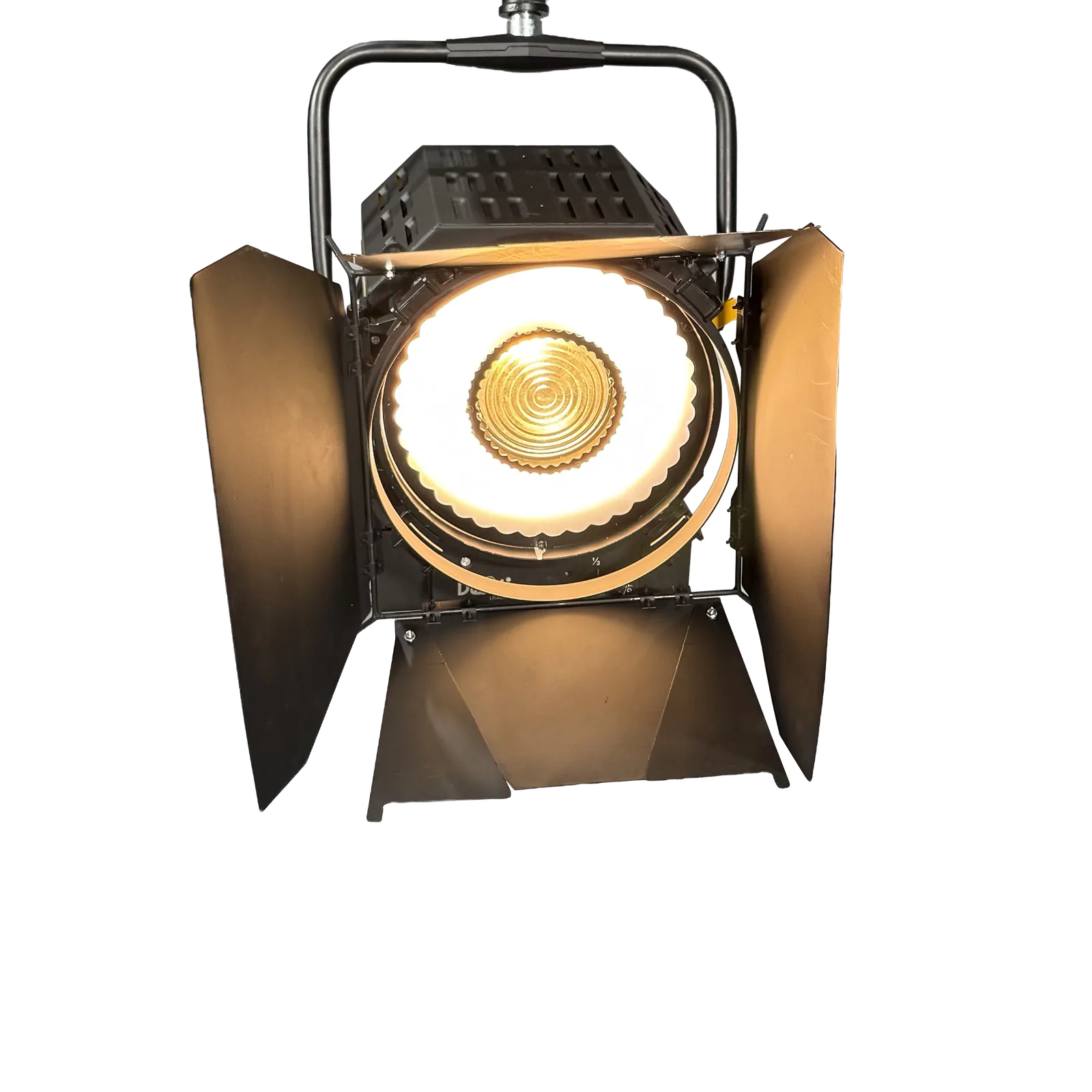
The shadow becomes a parameter
On a Fresnel the fixture decides the shadow: hard, and that's it. On a soft light it's diffused, and that's it. Going from one to the other means changing fixture, or adding diffusion in front. Galileo keeps both sources on the same axis and controls them separately: the shadow moves from crisp to soft continuously, and every step in between is a working position, not a compromise. You set it from the console, with the set standing.
Every position in between is a working position.
When the background changes, the shadow changes with it
In studios with an LED wall or a dome the background doesn't stand still: a cloud passes, the light drops, the sun comes back. If the light on the subject stays exactly the same, the eye notices before it understands why — and what usually gives it away is the shadow. With Galileo the shadow follows the background live, from the same fixture: it softens as the cloud passes and comes back crisp when the sun returns.
A Fresnel and a ring, on the same axis
A true Fresnel lens at the center; around it, a ring of soft light. Two independent engines emitting from the same axis — which is why the two lights never split and the shadow stays single while it changes nature. It's a category that had no name: we called it SoftNel, and it is patent-protected.
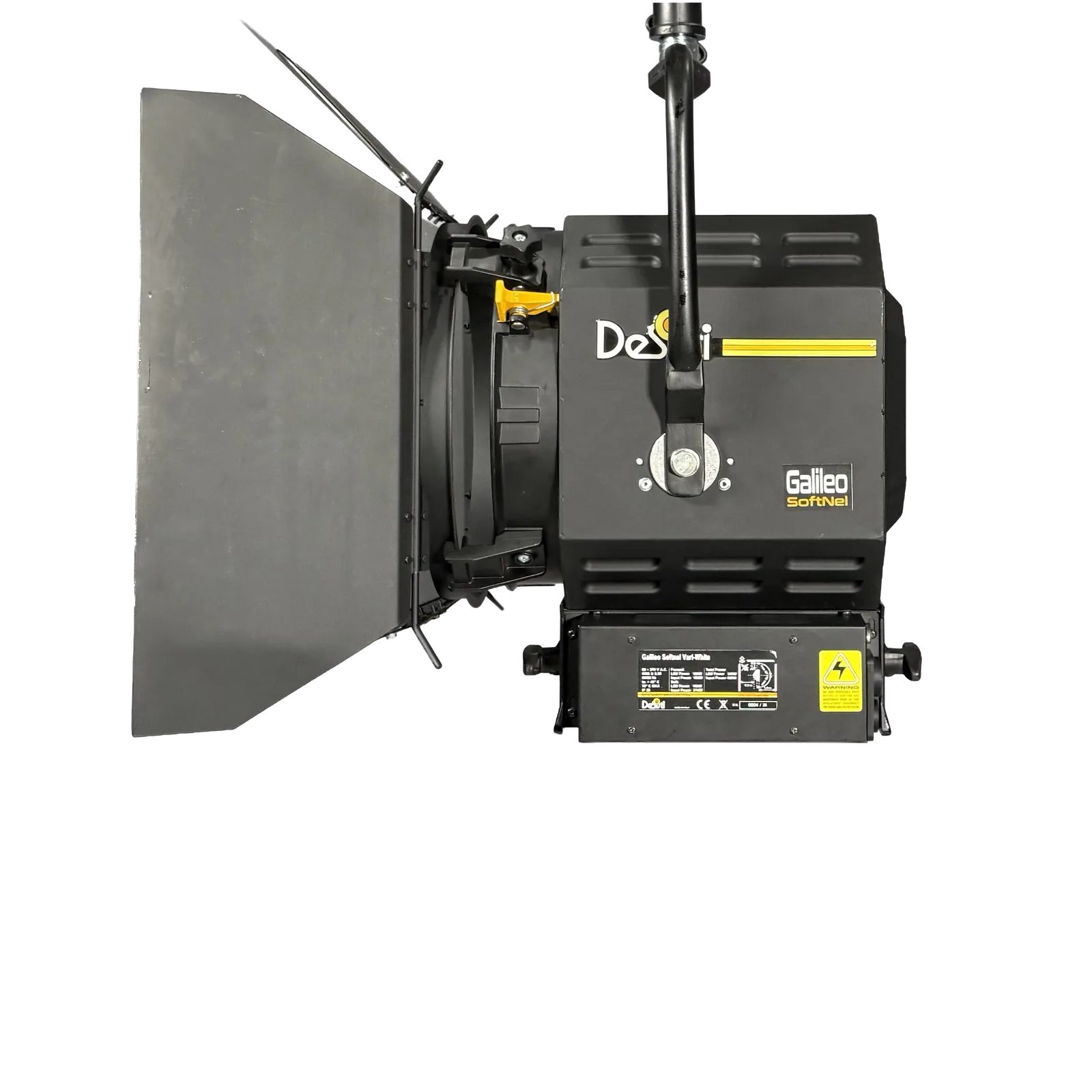
Galileo SoftNel
The cycle: sun, cloud, sun again
Same scene, same bouquet, the same fixture in the same position: only the light changes. The cycle runs from the hard shadow of the Fresnel to the soft one of the ring, and then comes back — and the way back is not the clip rewound: climbing towards hard light draws shades of its own. Walk through it, stop by stop.
The five stops of the cycle
The clip shows the continuum; here the passages are taken apart one by one, on the shots from the working prototype.
 01 · Fresnel only
The hard shadow
Only the Fresnel engine is working. The bouquet stands out crisply against the wall: defined edges, every leaf readable inside the shadow. This is light with character — it sculpts, and it forgives nothing.
 02 · Mix
The edges open up
The Fresnel comes down, the ring comes up. The edges stay readable but they start to open, and two qualities of light live on the subject at once. This is not a switch between two states: the whole continuum sits in here, and every point along it is a working position.
 03 · Soft only
The shadow almost dissolved
Only the ring is working. The shadow is barely there on the wall and the light wraps around the subject: no hardness left. This is where the cycle turns — you can stay here, or come back.
 04 · Mix, returning
The shadow gathers again
Out of the near-dissolve the edges come back, but the gradation is not the one from the way out: climbing towards hard light is a story of its own, with its own way of pulling the edges together. Same stretch of road, different reading — which is why the cycle is worth walking in both directions.
 05 · Fresnel again
The circle closes
The shadow is hard and crisp again: the cycle ends where it began. No change of fixture, no diffusion in front of the lens, nobody walking onto the set. From the desk, with the set standing.
This is the opening frame again: the shadow has come back to exactly where it was.
The five stops are the pillars of the cycle: in between, the fixture travels through every intermediate shade.
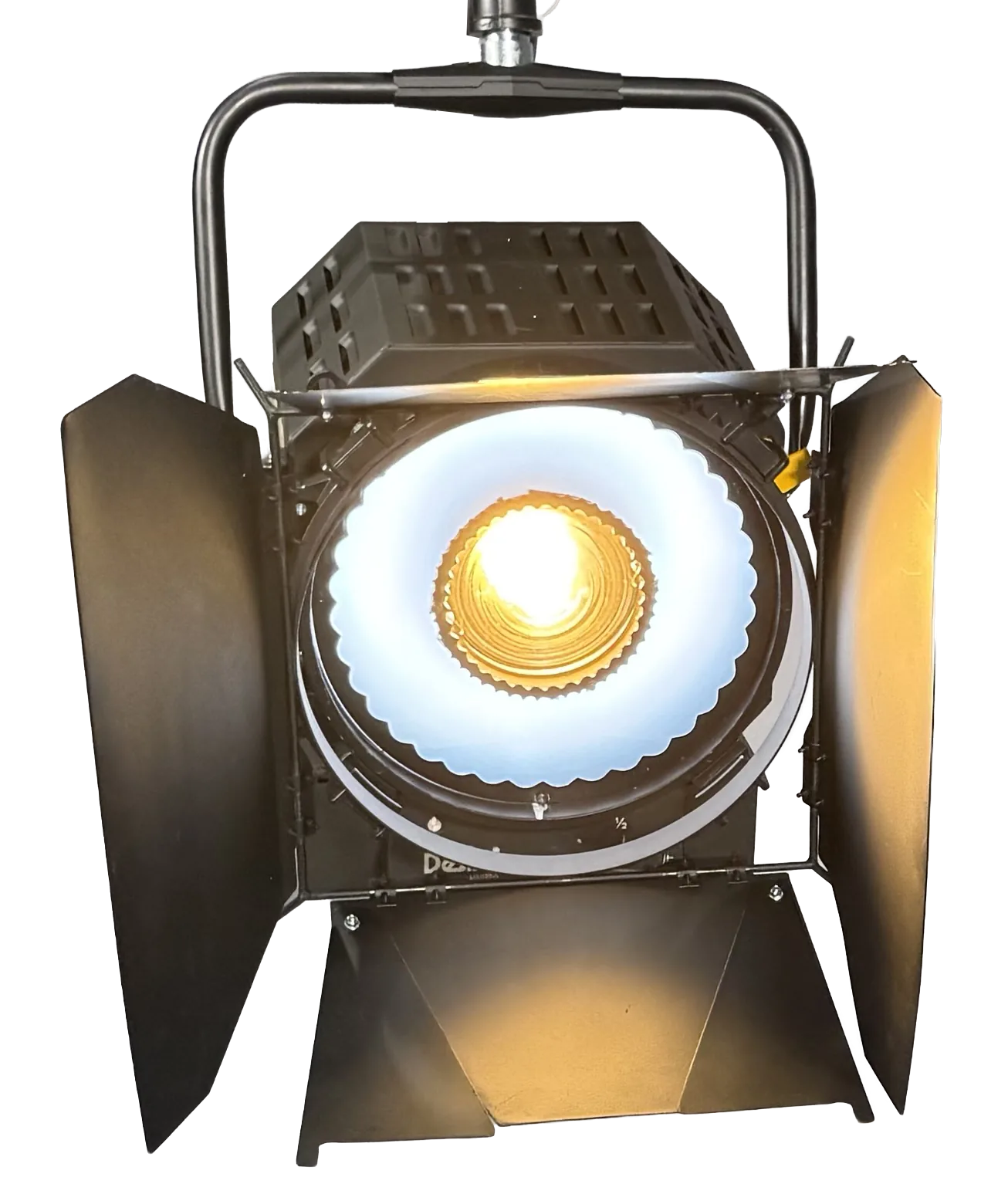
Center and ring at two different whites
One step from the definitive Galileo
Two engines on one axis — the hard shadow of the Fresnel, the soft shadow of the ring — in a single body. The unit coming to Amsterdam is the closest Galileo yet to the fixture it will become. These are the figures it carries.
- 185 W + 185 W to LED — one engine for the Fresnel, one for the ring
- 2,800–6,600 K with CRI >95
- Fresnel beam 14°–60°
- Independent color temperature per engine — center and ring can work at two different whites, as the photo shows
Figures from the pre-production unit. Full specifications will follow with commercial availability.
See Galileo at IBC
Amsterdam, 11–14 September 2026
Galileo takes center stage at our booth: switched on, adjusted live — and you move the shadow yourself.
Book a demo at the boothGalileo comes out of the same optical work as our Fresnels: the same care on the beam, the same idea of a shadow.
Explore the De Sisti Fresnels →